
Last updated on: October 25th, 2026 21:56 pm
Understanding how does a turnstile works means looking past the rotating arms or glass panels and seeing the sequence that connects a credential, a controller, and a mechanical or optical barrier.
A turnstile is a pedestrian access control gate that permits only one person to pass through at a time, combining mechanical barriers, access readers, a central controller and infrared sensors to manage entry and exit securely. It exists to answer one question—is this person allowed through?—and to enforce that answer physically. Turnstiles are widely used in offices, stadiums, metro stations, factories, gyms and high-security facilities to regulate foot traffic, prevent unauthorised entry and stop tailgating.
How does a turnstile work? (The core working sequence)
The working principle of the turnstile barrier security gate is to detect the movement of personnel entering and exiting through sensors, and to control the motor through the control system to drive the opening and closing of the turnstile gate, thereby achieving control and counting of personnel flow.
All modern electronic turnstiles follow the same basic workflow:
- Credential verification: The pedestrian presents an access credential to the reader. This can be an RFID card, QR code, PIN code, fingerprint or facial recognition. The reader sends the data to the access controller for validation.
- Authorisation signal sent: If the credential is valid, the controller sends an unlock command to the turnstile’s drive mechanism. If the credential is invalid, the gate stays locked, and an alarm or prompt may activate.
- Barrier releases: The locking mechanism disengages. Depending on the turnstile type, rotating arms, glass flaps or swing panels unlock to allow passage. Semi-automatic models let users push the barrier; fully automatic speed gates open the panels automatically.
- Sensor detection during passage: Infrared optical sensors installed across the passage track the pedestrian’s movement. These sensors detect someone walking through, trigger anti-pinch protection, and identify tailgating or reverse entry attempts.
- Automatic reset and re-lock: Once the person fully clears the channel, the turnstile automatically resets and locks again. It will not grant access to a second person without a new valid credential. This is the key function that prevents tailgating and piggybacking.


The turnstile gate is usually equipped with sensors and control systems. When personnel need to pass through, the sensors will detect the presence of personnel and trigger the control system to open the turnstile gate; On the contrary, when no personnel pass through, the turnstile gate remains closed to ensure safety management.
How different types of turnstiles operate
Tripod turnstile
The most common waist-high turnstile with three rotating metal arms arranged in a tripod shape. After access approval, the lock releases the rotor. The user pushes the arm to rotate and walk through. Once rotated, the arm locks back into position. Tripod turnstiles are durable, cost-effective and popular for factories, construction sites and stadiums.
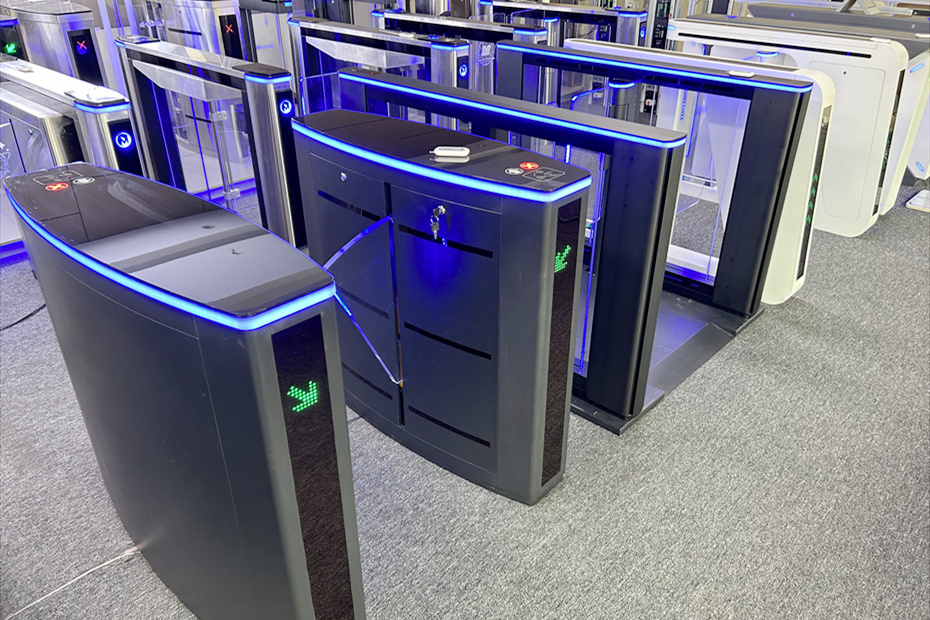
Flap barrier turnstile
Transparent acrylic or glass wing panels pop out from the cabinet when authorised. Optical sensors monitor the passage and stop the flaps from closing if a person is still in the channel. Flap barriers are compact and fast for office buildings and metro stations.
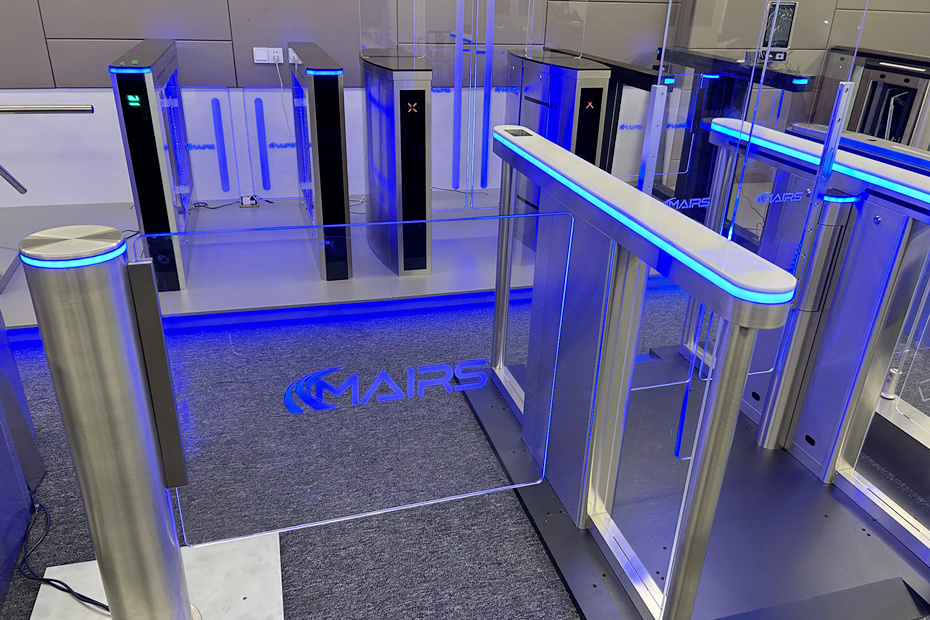
Speed gate turnstile / Swing Turnstile
Premium glass swing turnstile gates with fast, silent servo motors. They open quickly for high-volume pedestrian flow, often used in corporate lobbies and airports. Many models support wide passage modes for wheelchairs, strollers and luggage.
Full-height turnstile
A tall, floor-to-ceiling rotating cage rotor. It works like a revolving door and offers maximum security. People cannot climb over or duck under it. It is widely deployed in prisons, data centres and high-security industrial sites to block unauthorised access completely.
Sliding turnstile
Sliding glass panels retract sideways when access is granted. It creates a clean aesthetic and wider passage, commonly found in modern commercial buildings.

Key built-in safety & security features
Modern turnstiles rely on more than just mechanical locks. Integrated sensors and controllers deliver critical protection:
- Anti-tailgating: Optical sensors detect a second person trying to follow closely after an authorised user and trigger an alert.
- Anti-pinch protection: Sensors stop the barrier from closing on people to avoid injury.
- Emergency release: During power failure or fire alarms, barriers unlock automatically to allow safe evacuation.
- Directional control: Administrators can set one-way or two-way passage rules for entry and exit.
- Passage counting: The system records the number of people entering and exiting for real-time occupancy tracking.
Mechanical vs electronic turnstiles
Basic mechanical turnstiles work without power. They only allow one-way rotation and rely on human pushing, with no credential verification. They are simple and low-cost but lack access logging and anti-tailgating alerts.
Electronic turnstiles connect to access control systems. They validate credentials, record access logs, trigger alarms and support remote management. Most commercial and security projects choose electronic turnstiles for full audit and security control.
In general, the turnstile gate is composed of identity verification, signal transmission, gate control mechanism, traffic detection and alarm system, etc., to achieve control and management of personnel passage. This helps to improve security and ensure that only authorized personnel can enter specific areas. Different types of security gate turnstiles may have different specific implementations, but the basic principles are similar.


Common faults of turnstile gate
1. The turnstile gate has been alarming: check whether the infrared is not aligned or damaged (when the turnstile gate is powered on, don’t block the infrared. Go to the tail of the infrared receiving end to see if there is a light on. If there is a light on, try to realign the infrared transmitting end and receiving end. If you can’t do anything, the infrared may be broken. You can replace it. If you can’t replace it temporarily, you can cut the wire).
2. One side wing rod of the flap barrier gate can come out, and the other side can not come out, you can change the position of the red and black line of the motor at the host end. If not, the mainboard may not communicate, so you can only replace the mainboard.
3. After swiping the card, only one side of the gate can work. Check whether the online line of the main and auxiliary machines of the turnstile gate is normal.
4. The swing turnstile gate motherboard prompts that the encoder value does not change, which is most likely because the zero position of the turnstile gate is not adjusted properly. Method of adjusting zero position: there is a white line on the encoder and a yellow line below. Loosen the machine screw to adjust the position of the yellow and white lines to ensure the alignment of the yellow and white lines.
5. The turnstile gate of the limit switch indicates that the motor movement times out, which means that the limit switch does not work normally. The limit switch may be broken. The most likely reason is that the position of the limit switch is too far. You can adjust the position of the limit switch to solve it.
Above is the basic working principle of security turnstiles. Want to know how does a turnstile work, we still need to know how does the turnstile access control system work? Security turnstiles gate access control system belongs to one-card type, with CPU processor as the core controller, information collector, and electronic control lock as an auxiliary to form a complete control network.
According to loading and reading information content, the automatic control system of the gate is completed. The traditional gate access control system is usually managed by id and ic cards. With the development of science and technology, the intelligent management of access control systems is improved by adding human certificate verification, scan code verification, face recognition verification, and so on.

At present, many public places, such as office buildings, stations, tourist attractions, manufacturing factory, and so on, have started to use security turnstile gate access control system software to carry out staff management. The important reason is that the turnstile gate is unique and durable. Especially at the subway entrance, the metal detection door of the subway station can be connected with the software of the security turnstile gate access control system. In addition, facial recognition can replace the previous human resource inspection method to verify, which not only saves money allocation but also more accurate verification results. Effectively prevent all kinds of accidents. So how does a turnstile work is a necessary knowledge we need to know.
Intelligent security turnstile gate is mainly for entrance and exit management, including tripod turnstile, swing turnstile gate, flap barrier, and full height turnstile. Its working model is mainly reflected in four aspects: how does a turnstile work
Types of turnstile configuration systems
1. Wireless remote control: wireless remote control can be installed to implement short-range wireless control;
2. Fingerprint control: people pass through the designated fingerprint identification verification, fingerprint security turnstile is mostly used in enterprises, institutions, government organs, and other places;
3. Card swiping control: countable card swiping access control, consumption control, time recording control, time period control, etc;
4. Face recognition control: through face recognition identification and control, it is generally used in the community, site attendance, building personnel passage, etc;
5. QR code identification and control: Control the passage through mobile phone QR code scanning, it is applicable to the charge processing of scenic spots, the passage processing of exhibition personnel, etc. If you want to know more details, you can check our another article: how does QR code turnstile gate work?
FAQ
Q: Can a turnstile let more than one person pass at once?
A: Designed to allow one person per valid credential. The optical sensor system detects tailgating and keeps the barrier locked until the channel is clear. Wide-passage modes can be activated for wheelchairs or large items.
Q: What happens when power is cut off?
A: Most compliant turnstiles unlock automatically in a power outage for emergency evacuation, especially for public buildings.
Q: Can turnstiles integrate with existing access control systems?
A: Yes. Standard turnstiles support dry contact, RS485 and TCP/IP communication to connect with card readers, biometric devices and central management software.
Q: Where are turnstiles most commonly used?
A: Gyms, corporate offices, stadiums, public transport stations, manufacturing plants, construction sites, airports and secure data centres.

Conclusion
At its core, a turnstile works as a physical access checkpoint: it verifies identity, unlocks the barrier for a single authorised person, uses sensors to monitor movement, and locks again after passage. Choosing the right turnstile type depends on your security level, pedestrian traffic volume, aesthetic requirements and accessibility needs.
So according to the working mode of the above turnstile gate, we probably know how does a turnstile work, we probably understand that the turnstile gate can be customized according to the different requirements of the customer. If you want to know more about types of turnstiles? please check our product page. If you need a special turnstile gate, We can provide you with quality customized service and the most reasonable price.